
Culture
Clint VS Koundé: The Flyest Football Crossover Of Paris Fashion Week

Last week, as Paris Fashion Week was in full swing, the growing influence of football in the fashion industry became increasingly clear. With Mario Balotelli walking the runway for KidSuper and Myles Lewis-Skelly making his debut for Wales Bonner, this year’s Fashion Week epitomised the cultural zeitgeist of the modern game.
One figure in particular was quite literally everywhere. Jules Koundé was prominent in his home city, proving he’s comfy in his ends as he becomes a physical embodiment of the connection between football and fashion. But serving looks wasn’t all the French international got up to last week.
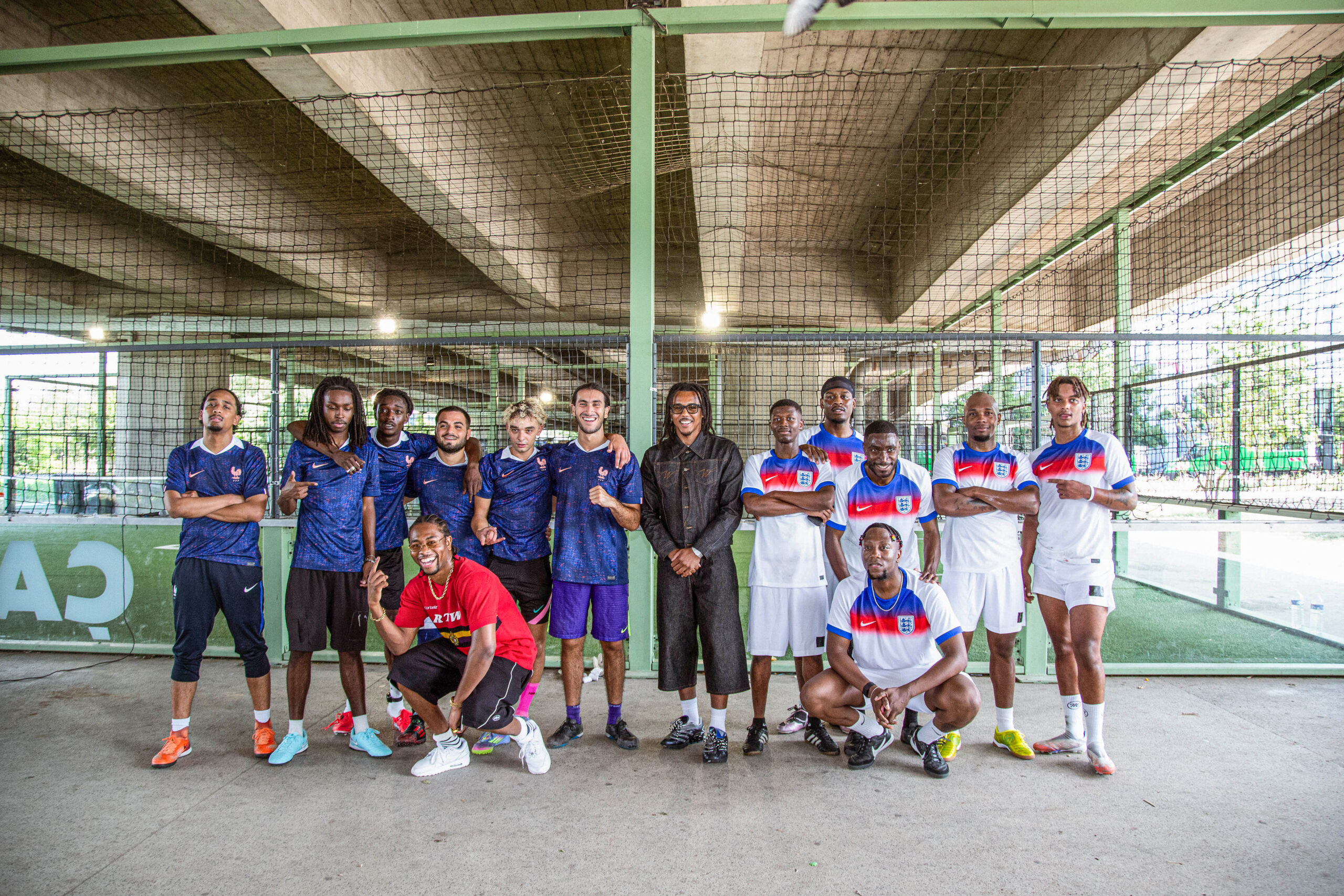
As the streets of Paris boomed with fashion enthusiasts, infamous designers, and world-renowned athletes, tucked away in a corner of the city, a match took place, as the two worlds collided in an unprecedented link-up.
Instagram hosted a UK vs France football match, calling on Jules Koundé and Corteiz founder Clint as gaffers for the respective teams. An entertaining affair, the match ended 8-7 in favour of Team UK. But beyond the game itself, this link-up represents a watershed moment in the cultural permeation of football.
With both industries renowned for their creativity and individuality, we spoke to Koundé and Clint to deep dive into the football x fashion wave, who they think is running the game right now, and where they draw inspiration from.
View this post on Instagram
Footballer Fits: Who are your top three flyest ballers in the game right now?
Clint: “Definitely Rafael Leão. Lamine Yamal will be super fly in a couple of years, and Jules is also fly.”
Koundé: “Rafael Leão for sure, and I have to say myself. [laughs] I also like Kobbie Mainoo, he’s doing his thing at the moment.”
During your career, how would you say you’ve seen the football and fashion wave develop?
Koundé: “I think it’s always been a thing, looking back you had icons like David Beckham. We also don’t talk enough about Djibril Cissé, a French icon, he was the first to do blonde hair. I think fashion and sport have always been related, but I just think right now we’re in a space where the young generation is starting to express it more. It’s okay to be into fashion more than it used to be, so I’m happy.”
Has the football fashion wave become oversaturated and inaccessible?
Clint: “I don’t think oversaturation is a bad thing when there’s a demand for it. I feel that naturally, footballers want to explore other avenues while they can because football can be quite restrictive. So a way to express yourself creatively is through your style, and I think it’s just a natural human feeling. In terms of inaccessibility, a lot of brands are making football boots, for example, but they make it for their audience and their consumer base. But there’ll always be stuff that’s accessible for people who can’t afford it, you’ve just got to pick your level and pick what you resonate with.”
Your outfits are often super creative and very varied, where do you draw inspiration from and what has shaped your fashion style?
Koundé: “I never had a reference, but I get a lot of inspiration from my hobbies, which are fashion and movies. I’m a big movie guy, so I always like to check how I feel in movies and get inspiration — one of my favourite movies is Heat. Pharrell is an inspiration because he comes from the music world but has always been into fashion and seeing him at the top of Louis Vuitton is inspiring. The inspiration I get from him is about being able to showcase different sides of my personality because I’m a footballer but football doesn’t define me.”
How important are inspiration and authenticity when creating football fashion pieces?
Clint: “Whenever I collaborate it’s always about what makes sense, and a lot of the time you can see I’ve said something in the past in terms of who I’ve wanted to work with. So it’s never really a lie, that’s just how I genuinely feel. So working with Balotelli was amazing, and that was just an authentic moment. I like it when a player turns up in an extravagant fit and then another player just turns up in a Nike Tech — that’s just how they are. As professionals, they’re both at the same level mentally, but it’s just a human difference — if a man wants to get fly, let him.”
Can we get a sneak peek at who the next linkup might be with?
Clint: “In terms of shooting or linking up with different ballers I can’t even say the name, it’s a forbidden name. It’s just I can’t tell you who’s next, sometimes it’ll be like we should work with my man and it’s just organic. Working with Kobbie was last minute, and even working with Phil Foden was a spur of the moment. A lot of the time it does depend on whether or not they’re a Nike athlete. But outside of that, maybe there’s some way I can work with Jules in the future, maybe I’lljust crop his shoes. [laughs]”
Koundé: “Just switch, man. Just switch. Come to the Three Stripes. [laughs]”

The inaugural Como Cup came to a fitting conclusion on Sunday evening as the hosts lifted the trophy, courtesy of a convincing 3-0 over Ajax, with an impressive drone show during the trophy presentation, the cherry on top of an event that has set the bar.
The pre-season tournament was part of Football On The Lake, a five-day festival that intertwined football, culture, and music in the iconic setting of Lake Como.

Invitees included Celtic, Ajax, and Al-Hilal, bringing some of the biggest names in football to the most iconic setting in the game — with Riyad Mahrez, Ivan Toney, Franck Kessie, Sergi Roberto, Nico Paz, Rayane Bounida, and Kenneth Taylor all competing for the ultimate prize.
While the hosts will be emboldened by their triumph, the festival represents a wider shift in the relationship between football, culture, and music. The first of its kind, Como 1907 have become a trailblazer, recognising the value of intersecting different mediums through the lens of football.

However, the performances on the pitch weren’t the only highlight of the week, as iconic artists such as Becky Hill, Sick Luke, and DJ Patrick Nazemi were on hand to keep supporters entertained in between matches.
High-profile guests, including Giggs, Avelino, and ASAP Nast, not only raised the profile of the event, but they also reminded us of the power of intertwining various cultures, with the crossover for the summer proving that football belongs to all.

Como’s grip on the culture was further evident, with Creative Director Rhuigi Villaseñor, founder of American fashion house Rhude, a prominent figure throughout the week. Not only was he present for the trophy presentation, but a pop-up shop in Como offered attendees the chance to get their hands on one of the flyest football x fashion collaborations in the game. Since joining the club, Rhuigi has been making waves in the kit game, fusing the iconic scenery and culture of the city with Rhude’s signature style.
More than just a five-day festival offering attendees a taste of all the city has to offer, football, fashion, music, and culture, the inaugural Football On The Lake epitomises the modern game. Rather than shy away from the modern cultural zeitgeist, Como embraced these influences on the game and have set the standard when it comes to football culture.

Undoubtedly aided by their position in one of the most beautiful parts of the world, the off-pitch recognition of where the game is headed sets them apart from their nearest competitors, and their success on the pitch reinforces the club’s overall commitment to excellence in all aspects.

In today’s digital-first era, footballers have become more than just athletes. While social media in sports is not new, the last few years have marked a turning point. Players are increasingly bypassing traditional media to control their narratives, offering fans unfiltered access to their lives both on and off the pitch. More than a quest for visibility, this shift is redefining the media landscape, with authenticity at the forefront of the new wave. From YouTube documentaries, to curated Instagram dumps, and spontaneous Snapchat stories, a new era of football storytelling has arrived.
Many of us remember when Ryan Babel became the first footballer to get fined for a tweet back in 2011. Babel was charged with improper conduct by the FA for posting an edited picture of referee Howard Webb wearing a Manchester United shirt, captioning it “And they call him one of the best referees? That’s a joke. SMH” An unprecedented event, the then Liverpool forward was fined £10,000 for the tweet. Most footballers’ online presence in the past was often light-hearted and innocuous, with Wayne Rooney’s iconic tweet that same year, “Hi rio do u want picking up in the morning pal” repeatedly resurfacing.
Hi rio do u want picking up in the morning pal
— Wayne Rooney (@WayneRooney) April 23, 2011
Social media has been a consistent presence in the game, but 2024 marked a monumental shift in the relationship between footballers and online platforms. As the demand for traditional legacy media declined, a vacuum for unfiltered interaction emerged.
More players are taking control of their narratives through independent digital platforms. Both Cristiano Ronaldo and Jude Bellingham have pivoted to YouTube, creating their own channels to communicate with their audiences. Since starting the channel in July last year, Ronaldo has accumulated 75 million subscribers and a total of 846 million views, reiterating the demand for more access to the legendary player.
Compared to Ronaldo’s more light-hearted content, Bellingham’s channel is more curated. In September, the English midfielder released his self-made documentary ‘Out Of The Floodlights’ exclusively to his YouTube channel. Accumulating a total of 15 million views on both his documentary and additional exclusive content, it’s clear how much fans crave a glimpse into an athlete’s life. Significantly, Jude’s documentary was produced entirely by Bellingham Media Ltd, a company run by Bellingham’s parents and brother Jobe, giving him total control of the message. With a Netflix-level production, it’s interesting that the documentary was limited to YouTube, signalling a determination to control the presentation of a player who has soared to the top of the game since his emergence at Birmingham City.
Despite the respective successes of both Ronaldo and Bellingham on YouTube, there remains one app that dominates the footballing world.
Since launching in 2011, Snapchat has soared to the top, becoming a staple of modern digital media. And in 2024, we saw ballers truly embrace the app. The innately transient nature of the app, combined with its interactive features, has made it a player favourite to offer fans a glimpse into their lives. The allure of Snapchat is its raw nature, thriving on spontaneity, giving players the opportunity to connect with their audiences authentically without overthinking their posts. It has become a bridge between fans and footballers.
@footballerfits Alex Iwobi and Calvin Bassey even got Willian hitting the milly rock 😂 #football #fashion #viral #drip #fulham #alexiwobi #willian #premierleague #calvinbassey #nottinghamforest #dressingroom #funny ♬ original sound – Footballer Fits
The rise of the platform in the modern game is epitomised by the aptly named Snapchat derby, as Fulham and Nottingham Forest faced each other in the Premier League earlier this year. Ola Aina and Alex Iwobi are two prominent figures on the app, boasting 259,000 and 572,000 followers, respectively. As a result of their online presence, the game was given even greater significance on social media, with more than just the three points on the line for both teams. As Fulham emerged triumphant, in a 2-1 victory, the celebrations shared by Iwobi acknowledged the added significance of the win, with Issa Diop recorded chanting, “Team Snapchat!”
The acknowledgement of the online rivalry by both sets of players reiterates the rise of Snapchat, as they share genuine behind-the-scenes moments with fans, creating a connection that is difficult to emulate on traditional media outlets.
Beyond the two Nigerian internationals, there are numerous players who have welcomed the interactive features available. Erling Haaland’s stories epitomise the spontaneity of the app, as he varies between sharing his daily routines, his opinions on different matches and players, engaging in Q&A with fans, or even showing his gifting of a signed jersey to a fan from his hotel.
View this post on Instagram
As fans increasingly crave access to their favourite players, Snapchat has become the go-to medium through which players can engage with their audiences in real time. Offering an insight into changing-room antics, matchday routines, travel, and everyday activities.
However, it would be amiss to celebrate the current wave of players without paying homage to the OG’s of the Snapchat hype. Jesse Lingard is undoubtedly one of the biggest stars on the app flexing 1.4 million followers. Throughout his career, the forward has made an effort to share his personality with fans, and in an era where off-pitch access was rare, he was one of the first to give fans access. During his time at Manchester United, he was renowned for sharing interactions with teammates Marcus Rashford and Paul Pogba. Whether it was dancing in the changing room or sharing his matching fits with Rashford, he was an open book.
@footballerfits Admin misses the Marcus Rashford and Jesse Lingard bromance 🥺❤️ #football #fashion #viral #drip #manchesterunited #premierleague #lingard #rashford #bromance #funny ♬ original sound – Footballer Fits
Unfortunately, his playing spell at Manchester United coincided with a turbulent period for the club, and he was often villainised in the media for simply being himself online. Whether he was ridiculed for his dancing videos or chastised for his exuberant personality, he became a target as his expressionism was weaponised against him.
Thankfully, the current football scene has embraced the new generation of players who don’t shy away from sharing their day-to-day activities, and we must normalise players expressing themselves online. With footballers increasingly becoming dehumanised by overinflated playing schedules and regimented media appearances, the access they offer through personal, unfiltered communication, regardless of the platform, is cause for celebration.
From fit-checks, dressing room celebrations, and pranks to regular lifestyle insights, the value of footballers communicating with their audiences has increased massively in an era of media dominated by clickbait and engagement. The sheer authenticity provided by ballers through apps like Snapchat is part of a much bigger movement within the game towards athlete self-expression.
Whether it’s Snapchat stories, YouTube documentaries, walking at Fashion Week, or becoming the face of major fashion houses, the game is changing.